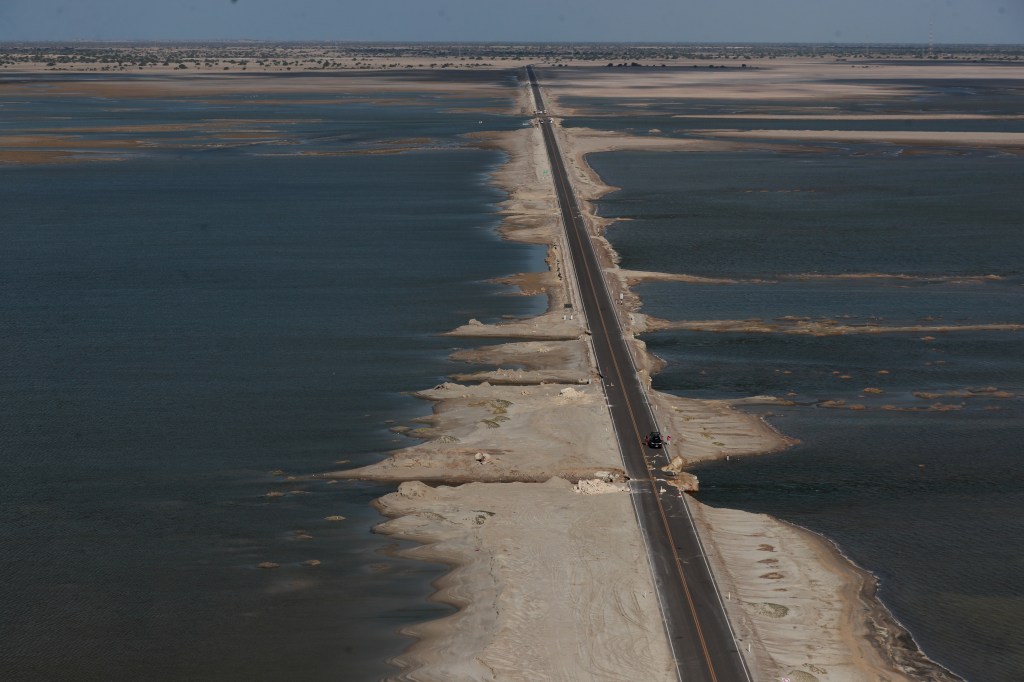
Lead photo: the Sechura desert, northern Peru, flooded by El Niño rains, March 2023. Ministerio de Defensa del Perú, via Wikimedia Commons, CC BY 2.0.
Past events show what 2027 may bring.
After my last post, a friend asked me what the new El Niño will bring to the Galapagos. They also asked me, more pointedly, what could be done. A Galapagos El Niño means no food in the sea and abundant rain on land. Rivers appear where there were none. One of my first jobs was working on the Ecuadorian coast in 1986. Everyone still talked about the 1982-83 rains; the coast saw 2,833 mm of rain, compared with a normal 126 mm. I saw the effects of these rains in 1992 when my study site in a dry arroyo washed into the sea along with hundreds of painstakingly marked lizards. I would find the marked lizards on the beach, even though they had been almost five miles inland months earlier.
That year, the Galápagos saw almost three times the normal rainfall during the prolonged 1991-93 El Niño. The Met Office recently said that the central Pacific is now warmer than during any prior El Niño. NOAA’s data to September 16, 2026, puts the central Pacific at 3 degrees Celsius above normal and the eastern Pacific at 3.8 degrees above normal, well past the record of 3.3 degrees set in November 1997. The Puerto Ayora sea surface temperature gauge read two degrees warmer than normal. At its peak, in December 1997, it was 4.4 degrees warmer. Many forecasters predict this will be a “super” El Niño and will probably last until April 2027. These events are called “El Niño” because the effects are increasingly apparent around Christmas. This post examines the effects of past El Niño events on the Galapagos, both at sea and on land, and explains ways to manage them.
Warm water and changing currents cut marine food chains.
On the 1987 guides course, we learned about the cold, deep-water Cromwell Current and the nutrient-rich Humboldt Current. El Niño weakens both flows. The Cromwell Current is an underwater current that hits Fernandina and western Isabela. The waters come to the surface, bringing cold water and nutrients, as anyone who has dived or snorkeled there will remember. Because of this current, most Galapagos penguins and all flightless cormorants concentrate on Fernandina and Isabela. An El Niño weakens the undercurrent and reduces or even stops the flow of nutrients and the phytoplankton base of the marine food chain.
Shifting from cold, nutrient-rich to warm, nutrient-poor seas harms corals, marine iguanas, sea-lion pups, penguins, cormorants, and most seabirds. Warmer waters and low nutrient content kill the algae attached to rocks, leaving marine iguanas’ feeding areas bare. The 1982-83 El Niño killed 97% of the Galapagos corals. Marine iguana numbers on Genovesa Island dropped from an estimated 15,000 to 900 during the 1997-98 El Niño. Sea lion pups starve; in 1983, on Santa Fe Island, only 19 of 140 made it past 5 months. Penguin numbers dropped 77 percent from a 1980 survey to a 1983 survey. Most seabirds will not breed during an El Niño, and many will leave the islands.
Some species recover quickly, but others take decades. Flightless cormorants recovered quickly after the 1982-83 event, but the penguins still had not fully recovered 17 years later. Corals, however, recovered slowly. Food web dynamics will change during El Niño, with some species responding rapidly and positively to the new conditions. Grazing sea urchins multiplied in 1982-83, possibly due to a release from normal predatory pressures from fish and lobsters. Sharks and turtles all left the Galapagos to move south. Fisheries and fishers in Peru also suffered. Normally abundant anchovetas will all but disappear from the system. The loss of this species hits fishmeal and fish oil exporters, costing more than US$1.4 billion, when the Peruvian government cancelled the 2023 season. In 1983, in the Galapagos, fishers shifted from grouper to the more abundant tuna, dorado, and wahoo.
Heavy rains turn dry ravines into rivers and spread invasives.
The rains can create rivers, strip farm topsoil, and shift competition between native and invasive plants. In 1982-83, the Puerto Ayora station received 3,276 mm of rain, compared to a median of 277 mm. Rivers run down slopes, creating waterfalls reminiscent of tropical rainforests. Highland farms are substantially affected, as crops and topsoil wash down the fragile mountain slopes. Note, however, that not every El Niño brings heavy rains; the 2015-16 El Niño showed marine changes but only about 197 mm of rain.
Heavy El Niño rains turn the islands completely green across all zones. Darwin’s finches bred repeatedly. Compared with a normal year, the finches raised, on average, four times as many young. The best-studied finches in the Galápagos, on Daphne Major, laid up to 10 clutches in 1982-83, compared with one to five in normal years. During the 1997-98 El Niño, the highlands became an impenetrable jungle. The booms from the rains are short-lived, and the Genovesa plants and finches fell back to low numbers during the 1984-85 drought. These booms and busts create critical selection windows: variation arises during the boom, then shrinks to what survives the bust.
Heavy rains topple large Opuntia cacti, trap tortoises in ravines, and leave farmers with cows they cannot feed. The larger prickly pear cacti fall. They become filled with water, their shallow roots wash away, and stronger-than-normal winds blow them over. Researchers found giant tortoises dead on Alcedo in 1997-98, caught in flash floods in ravines. Above all, invasive species spread fast during the rains. Blackberry, Lantana, and castor beans spread noticeably in 1997-98. Then, during the 1998 drought that followed, Santa Cruz farmers asked the park to allow them to graze their increased herds on park lands.
Lands can be managed; the ocean can’t.
On Ecuador’s mainland, flash floods destroy or wash away many bridges. In 1982-83, the main highway to the coast was impassable. At the same time, 13 bridges in the peninsula were washed away. The 1997-98 floods in Guayas ended up with the deaths of 61 people. Tourism numbers to the Galapagos remain relatively unaffected.
The park can clear invasive species after the rains but may not have enough personnel. The national park director has already said that the park needs 50 more rangers for this year and next year. The park has also set aside US$500,000 in initial funds for training, tools, and supplies. Once the rains start, rats and feral cats will likely become a growing problem. The invasive plants that outcompete the delicate Scalesia daisy trees are likely to receive a massive boost. Blackberry removal already helps Scalesia by reducing mortality and improving recruitment, but this may change this year.
The Charles Darwin Foundation and the Galapagos National Park will continue monitoring to measure and better manage effects. The Charles Darwin Research Station has measured rain at Puerto Ayora since 1964, providing a baseline. Since 1977, these two institutions have monitored cormorants. This long-term monitoring information is crucial for the future, as it helps us manage what we can of the impacts of El Niño.
The islands will recover but may need help now.
Monitoring and decision-making based on that information are critical to both land and sea actions. Both Peru and Ecuador have national approaches to better understand and manage the effects of El Niño. Peru has a national multi-sector El Niño study commission (ENFEN). Ecuador has a national El Niño committee (ERFEN) with strong links to data gathered by the National Oceanographic and Antarctic Institute (INOCAR). ERFEN officially declared an El Niño event in Ecuador on August 28, 2026. Ecuador has declared a national red alert, including the development of evacuation protocols for vulnerable areas, and already has contingency plans across affected sectors. Peru has declared a four-month emergency across fishing and aquaculture and is strengthening flood defences. You will notice the changes when you visit the islands. Most visitor sites will stay open unless they are damaged, as happened on Isabela in 2016. The penguins may be harder to find. Yet the highlands will be green. The waters will be clear, but there may be less to see.


Leave a comment